Bimdoc steps onto the production floor
Bimdoc was born in the process industries. Plant structures per SSG 5275, document classes, drawings, projects and deliveries. But the same information problem exists in every factory, whether it cooks pulp or assembles components on a line.
Over the past weeks we have been working with a manufacturer of marine systems, a company whose production runs through halls, lines and stations rather than blocks and departments. It gave us the reason to do something we had wanted for a long time: open Bimdoc's core model to discrete manufacturing.
A structure template, not a new product
The foundation is simple. Bimdoc's plant structure was never hardcoded to the process industries, it was built on templates. There is now a template for discrete manufacturing based on ISA-95: factory, area, line, station, equipment. Same engine, same document management, same classification. A workshop sees Area, Line and Station where a pulp mill sees Block and Department.
On top of the structure, the factory is drawn in Site Builder. The buildings sit on the satellite image of the actual plant, and one click on the production hall opens the floor view: the line, the stations and the material flow as a living layout instead of a binder of outdated drawings.
The station is the hub
Every station has a view of its own. KPIs against targets, the work process step by step with times against takt, current work instructions and control plans, the equipment, photos of tools and materials, today's checklist and the station's deviations. All linked to the same objects in the same information model, so a work instruction is a real document with revisions and review, not a PDF in a folder tree.
For the shop floor there is a station mode built for tablets. The operator sees their station, ticks off the setup checklist, reports the shift and searches for instructions, without needing to be an administrator and without being able to change anything by mistake. A new operator role separates reporting facts from changing definitions.
Honest KPIs without an MES
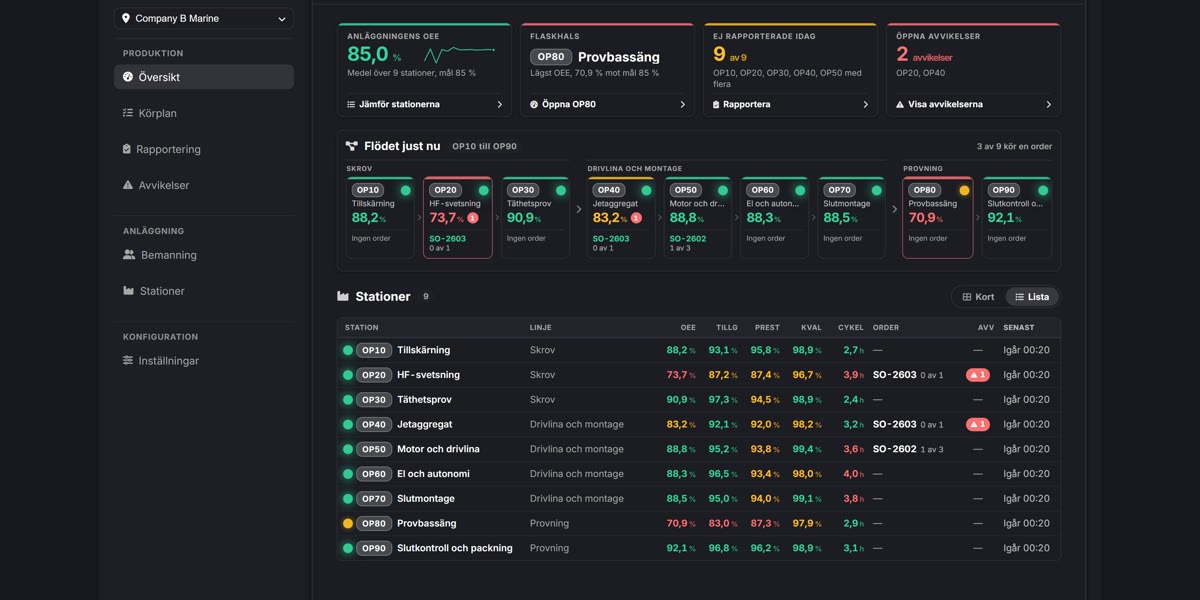
We do not believe smaller manufacturers need an MES to get honest KPIs. They need a simple way to report what the shift already knows: planned time, downtime, produced quantity, scrap. The system computes the rest. Availability, performance, quality, OEE and cycle time against takt, per station and per day, with every figure traceable to a human report that can be corrected afterwards.
The production manager opens the overview and sees the whole factory: plant OEE, the bottleneck, which stations have not reported and where deviations sit open. Not as a rigid reporting package, but as a living picture of the situation right now.
The information holds together
This is the same thesis we have argued all along. Information belongs to the company, and it becomes valuable when it is connected. The station on the floor is the same object as the station in document management, in the floor view and in the shift report. When quality engineers, operators and production management look at the same thing, nobody has to search, and the numbers mean the same thing to everyone.
The production module is now in the portal under Modules. If you want to see it for real, get in touch and we will gladly show it, preferably on site in your factory.