Information belongs to the company. Not the systems.
It is easy to think the next big investment is AI. We think many are starting at the wrong end.
Because AI is not what will decide which industrial companies succeed over the next ten years. Information is.
PwC's latest survey shows that most companies still struggle to get the business value they expected from their digital investments. At the same time, poor data quality and information management are named as some of the biggest obstacles to further progress.
That does not surprise us. We meet the same reality every day.
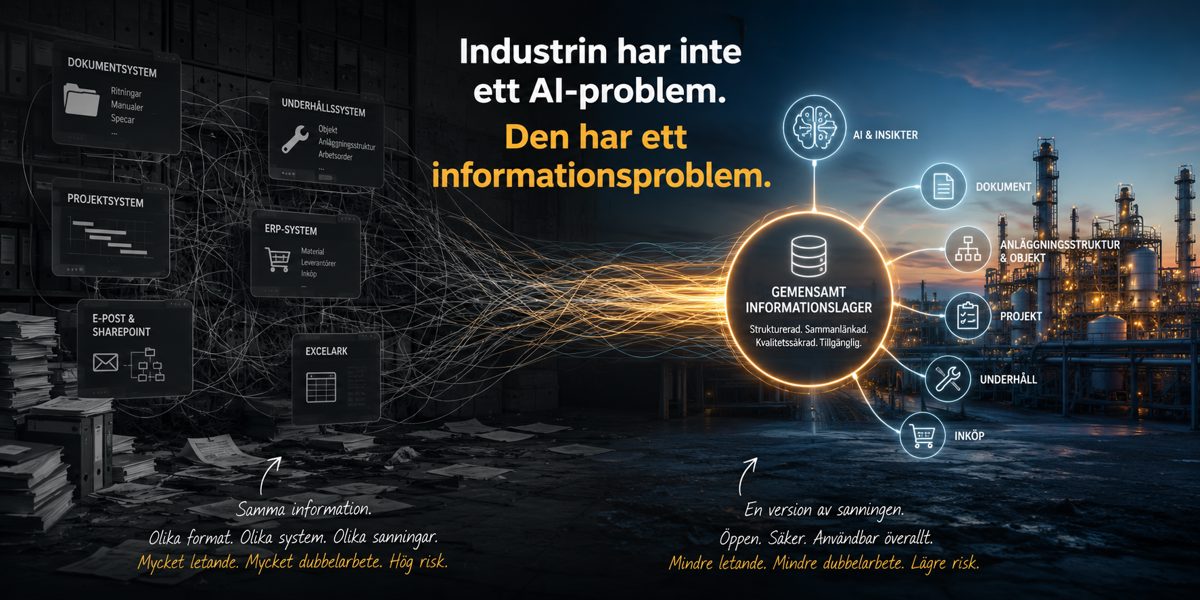
Technical information is everywhere. Drawings sit in a document management system. Objects and plant structure live in a maintenance system. The ERP system has its own structure. The document management system another. The project tool a third. Supplier documents are sent by email and uploaded into unconsidered SharePoint or Teams structures. Spreadsheets fill the gaps between the systems.
The problem is not that the information is missing. The problem is that every system thinks it owns the truth.
That forces people to search. The same information is registered several times. Relationships between documents, equipment and projects are lost. And AI? It runs into the same problem the people do.
Information is the company's most important asset
For a long time we have focused on digitalising documents and processes. Now we need to start digitalising the information.
Information does not belong to a system. It belongs to the company.
A business system should be good at business processes. A maintenance system should be good at maintenance. A project system should be good at projects. A document management system should be good at documents. None of them will ever be best at everything. Nor are they meant to be.
The industry of the future is not built on a single system. It is built on specialised solutions that work together.
So the question is not which system should own the information. The question is how the information can be made accessible, secure and usable, whatever systems the business chooses to use.
Systems should compete on functionality. Not on lock-in.
We think industry needs to leave behind the view of information as something to be shut inside each individual system. Open interfaces do not mean weaker security. The opposite.
A modern system can be both secure and open at the same time. It is about controlling who gets access, not about preventing information from being shared between the business's own systems.
When information is locked in, it is not only the users who are held back, innovation slows down too. If a system needs to lock in the customer's information to keep the customer, that is not a sign of strength. It is a sign that the market is not working.
Information is the company's most valuable asset. It should not be owned by a document management system, an ERP system or a maintenance system. It should be owned by the company.
We believe in a future where companies decide over their own information and are free to choose the tools that create the most value. Where specialised systems work together instead of competing over who owns the data.
Open APIs, shared standards and well-defined information models are not a threat to established systems. They are a precondition for innovation. Because no single vendor will be able to build every function the industry of the future needs. Development moves faster when several players contribute their respective strengths and when information can flow between the systems instead of getting stuck in them. That is the kind of digital ecosystem we want to help build.
AI needs context, not more documents
It does not matter how advanced an AI model is. If the information is incomplete, contradictory or scattered, the answers will be too. An AI needs to understand the connections.
Which pump belongs to which P&ID? Which instruments are part of the same loop? Which documents still apply? Which drawings have been superseded? Which equipment was actually installed during the project? Which spare parts belong to the equipment?
It is the relationships that create knowledge. Not the files.
That is why we build Bimdoc
We do not think industry needs yet another system. We think industry needs a better way to manage information.
At Bimdoc we build an information platform where documents, plant structure, equipment, projects, relationships and metadata are tied together into a shared information layer.
Where information only has to be created once. Where each system gets to do what that system is best at. Where information can be shared between systems instead of copied between them. Where people no longer have to search. And where AI gets the right conditions to actually create value.
We do not compete to own the customer's information. We compete to create the most value from it.
We think the winners of the future are not the companies that buy the most AI. They are the companies that first take control of their information.
Because when information becomes open, structured and connected, it is not only AI that gets smarter. The whole business does.
Source: PwC (survey on digital investments in industry).