When AI starts to act, industrial information has to be trustworthy
AI is leaving the chat window and stepping into the workflows of the business. The next phase is not just about finding and summarising information, but about AI agents that can carry out tasks, propose actions and interact with other systems. For industry, this makes structured and traceable plant information, grounded in recognised standards, at least as important as the AI model itself.
The development is moving fast. In KPMG's global survey for industrial manufacturing, 49 percent of the technology leaders surveyed report active AI use cases already creating business value. At the same time, 68 percent expect to be using AI at scale within the coming year.
But the survey also shows a clear tension: despite large investments and high ambitions, 76 percent point to unreliable data as one of the biggest risks with AI.
That is an important signal. Industry's next AI challenge will probably not primarily be about model capability, but about the information the models are given access to.
From finding information to acting on it
The first AI applications in document management have often been fairly narrow. The user asks a question and gets an answer based on, for example, technical descriptions, manuals or project documentation.
AI agents mean something more. In principle they can carry out several steps of a workflow: identify the equipment concerned, retrieve the associated documentation, check status and revision, propose the next action and pass the case on for review.
That also changes the risk picture.
An incorrect search result can be spotted and corrected by the user. An AI agent acting on the wrong document version, a faulty object link or an unclear status can instead carry the error onward into the business.
When AI moves from answering to acting, the systems must therefore be able to determine:
- which information is current,
- which part of the plant the information concerns,
- how documents and objects relate to each other,
- who owns the information and may change it,
- and which sources and revisions a decision rests on.
This is not a question that better language models alone can solve.
A searchable document is not the same as structured information
A PDF can hold valuable technical information and still be hard for a system to use reliably.
To interpret the document correctly, the AI needs its context. Does the drawing cover the whole plant or only a subsystem? Is it approved for use or just a working draft? Has the equipment been replaced since the document was created? Is there a later revision?
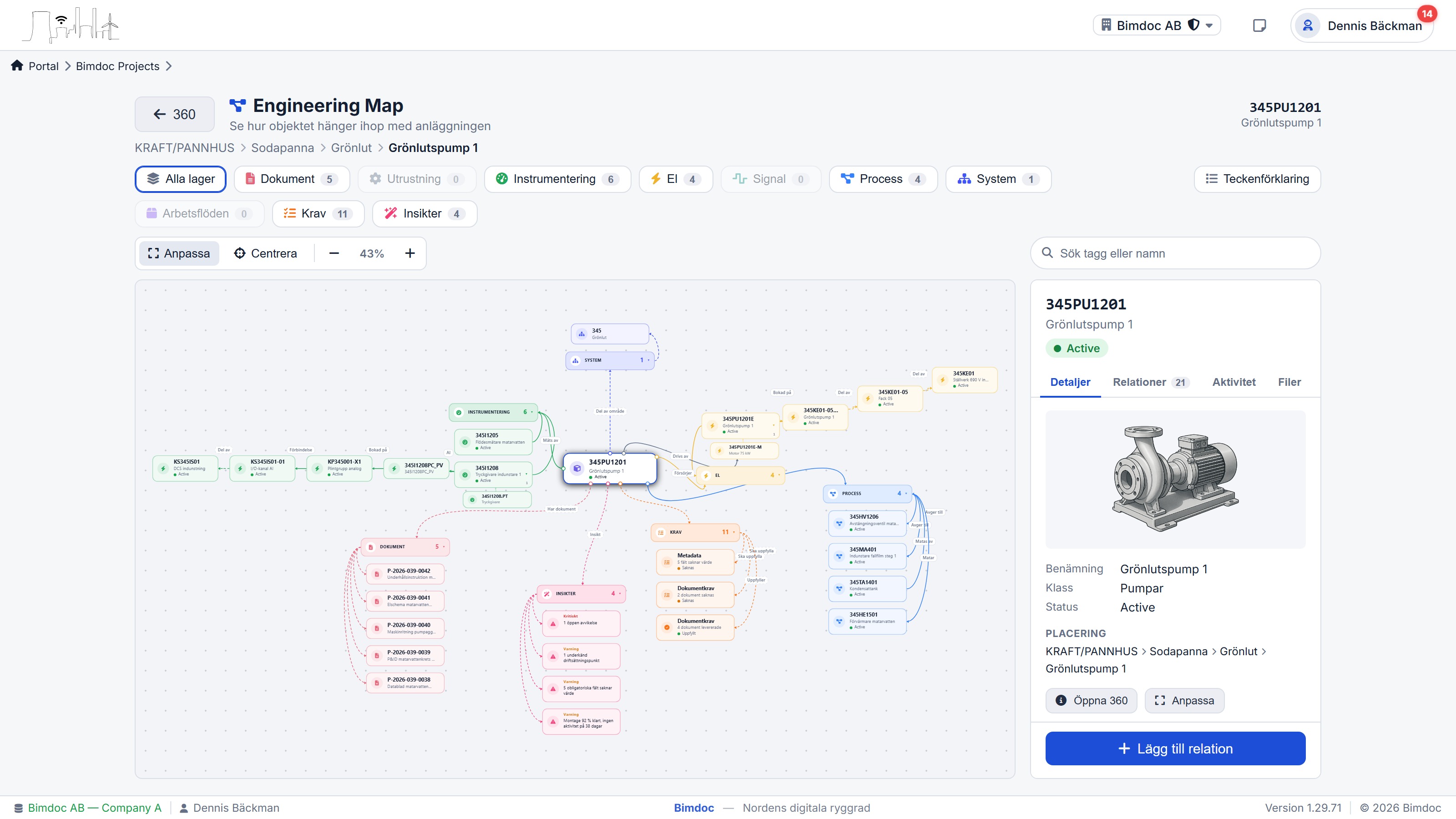
In a working information environment, documentation therefore needs to be linked to the plant structure and its technical objects. A pump belongs to a system. The system is described in a P&ID. The drawing has a revision and a status. The equipment may in turn be linked to datasheets, spare parts, inspection records and maintenance activities.
Only when these relations exist can AI begin to understand what the information actually means, and not just what the document says.
The difference may look technical, but it is fundamentally operational. It is about being able to trust that the right information is used in the right context.
Standards take on a new role
This development also gives established standards and shared information models greater weight.
At Hannover Messe 2026, the Industrial Digital Twin Association showed how the standardised digital twin Asset Administration Shell can create the conditions for industrial AI by giving data a semantic context. The same foundation is used for interoperable information exchange and digital product passports.
In July 2026, ASME presented a domain-specific AI model for engineering standards. The solution builds among other things on knowledge graphs and is designed for environments where accuracy, repeatability, traceability and trust are decisive.
Both initiatives point in the same direction: general AI needs to be complemented with domain knowledge, shared concepts and clear information relations.
Standards such as IEC 61355, SSG 5275, ISA-95, DEXPI and CFIHOS therefore become more than a way to classify documents and data. They can act as a shared grammar for people, systems and AI.
Traceability becomes a precondition
In an industrial environment, a convincing answer from an AI is rarely enough. It must also be possible to understand why the answer was given.
Which document was used? Which revision? Which technical object was meant? Which rule or information relation was behind the recommendation?
The more room to act an AI agent gets, the more important clear permissions, source references, event logs and limits on what may be done automatically become.
People do not disappear from the process. But their role can shift from manually searching for and compiling information to reviewing well-founded proposals and making the decisions where experience and accountability are required.
Is your plant information ready?
Ahead of the next step in AI, industrial companies should therefore not only ask which model or AI service to choose.
They should also ask:
- Can we determine which document version is current?
- Are documents, systems and technical objects linked to each other?
- Do we use shared names and classifications?
- Are information ownership and permissions clear?
- Can we trace how an answer or an action was produced?
If the answer is no to several of these questions, that is probably where the work needs to start.
For us at Bimdoc, this development confirms a direction we see as both natural and necessary. Digital documentation needs to be an integrated part of the plant information: structured, coherent and usable independently of any single system.
Our task is not to replace the judgement of the engineer, the operator or the maintenance specialist. It is to create better conditions for people and digital tools to work from the same reliable information.
Industry's next AI breakthrough may therefore not be decided by who has the biggest model. It may be decided by who has the best order in their context.

CEO, Bimdoc AB
Sources: KPMG Global Tech Report 2026, Industrial Manufacturing. Industrial Digital Twin Association, Hannover Messe 2026. ASME's presentation of domain-specific AI for engineering standards.